Learning Outcomes
i. Understand the concepts of food chains and food webs and their roles in ecosystems.
ii. Identify the transfer of energy and nutrients from one trophic level to another.
iii. Recognize the interdependence of species within an ecosystem.
i. Food Chains
A food chain is a linear sequence that shows how each living organism gets food, and how nutrients and energy are passed from creature to creature. Food chains begin with primary producers that synthesize food through photosynthesis, followed by consumers:
Producers (Autotrophs): These include organisms like plants and algae that produce their own food from sunlight.
Primary Consumers (Herbivores): These animals eat the producers, thus transferring energy and nutrients from plants to animals.
Secondary Consumers (Carnivores or Omnivores): These predators or omnivores eat primary consumers.
Tertiary Consumers (Apex predators): These are predators at the top of the food chain, consuming secondary consumers.
Decomposers: Organisms like fungi and bacteria that break down dead organisms, returning nutrients to the environment and completing the cycle.
ii. Food Webs
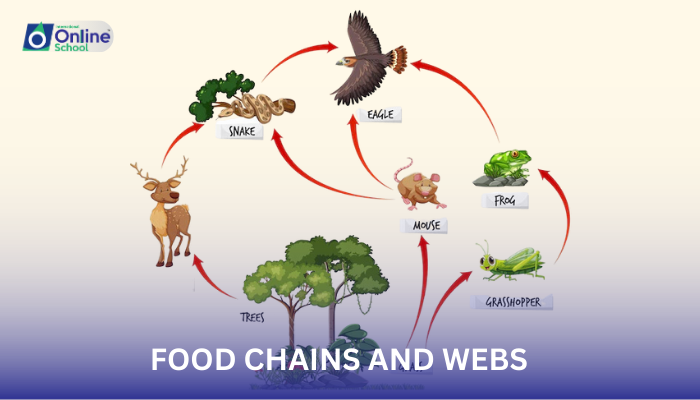
Food webs are more complex and realistic representations of the feeding relationships in an ecosystem. Unlike a food chain, which is a single pathway of energy flow, a food web illustrates how paths intersect and overlap, with many species acting as consumers at various levels:
A single organism may be part of multiple food chains.
Food webs show the interdependence of organisms within an ecosystem and how the disruption of one population can affect several others.
iii. Energy and Nutrient Transfer
In food chains and webs, energy is transferred in the form of food as one organism eats another. This energy transfer is not completely efficient because some energy is lost as heat due to metabolic processes. Nutrients are recycled as they are consumed and then released back into the environment by decomposers.
iv. Interdependence of Species
The structure of food webs illustrates the interdependence of species within an ecosystem:
If one species is removed, it can have a ripple effect on the entire community.
For example, if a primary consumer is removed, secondary consumers may lack food, and producers may overpopulate, possibly leading to overgrazing and soil erosion.
In conclusion, food chains and food webs are crucial for understanding the energy flow and nutrient cycling within ecosystems. They highlight the interdependence of organisms and how energy is transferred across different trophic levels. Understanding these relationships is vital for ecosystem management and conservation efforts, as it allows us to predict the impact of changes within the ecosystem.
